


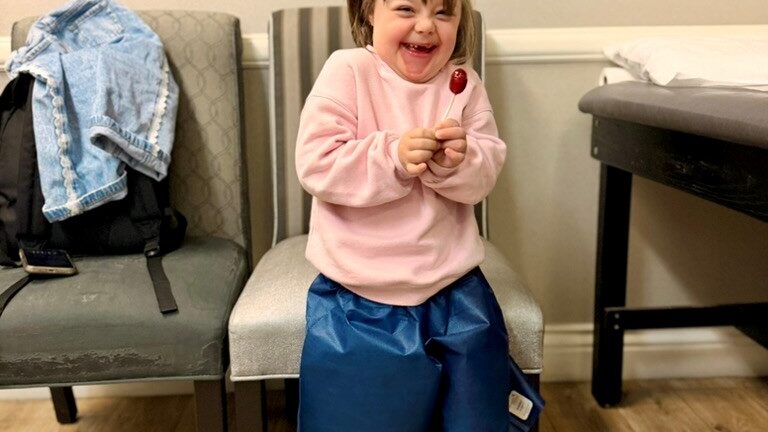
Kay recently had an appointment with an orthopedic specialist to take a closer look at her walking, toe-walking, and some of the tightness we’ve been noticing in her calves and Achilles tendons.
As part of the appointment, they also wanted to get some X-rays done, specifically of her hips and neck. Both of these are important areas that doctors pay attention to in individuals with Down syndrome, so let’s talk about that for a minute!
First up were her hips. Children with Down syndrome can have an increased risk of hip instability and hip dysplasia, partly due to hypotonia (low muscle tone) and increased ligament laxity, which basically means the ligaments can be looser than usual. The hip is a ball-and-socket joint, and when the joint isn’t as stable as it should be, the ball can shift partially or completely out of its normal position. This is something worth monitoring as children grow, especially since hip issues aren’t always immediately obvious.
The second X-ray was of her neck, specifically looking for something called atlantoaxial instability (AAI). This refers to increased movement between the first and second cervical vertebrae in the neck (C1 and C2). Individuals with Down syndrome can have increased ligament laxity, which can affect the stability of this area. In some cases, excessive movement can put pressure on the spinal cord, so it’s something doctors are mindful of. Thankfully, BOTH X-rays came back fine!
The neck is something that Kay will have periodically evaluated throughout her life, though. Even with normal findings now, things can change as she grows, so it’s important to continue monitoring when recommended by her medical team.
Now, back to the reason for the appointment!
After evaluating her walking and the tightness in her calves and Achilles, the specialist recommended getting Kay fitted for AFOs (ankle-foot orthoses). These are braces that help support the feet and ankles, improve alignment, and assist with positioning during walking. The goal is to help with her muscle tightness and overall gait.
The preferred goal is for Kay to wear them around 12 hours a day, although they’ll be flexible enough to accommodate her needs. They also want to get her back into physical therapy, specifically for gait training.
And here’s the funny part… I literally just stopped Kay’s physical therapy back in August. My hope was to give her a little more time to simply enjoy school without adding another therapy appointment to the weekly schedule. I wanted her to have some breathing room between school, ABA, and everything else.
Well, apparently we’re rearranging things again! LOL.
If there’s one thing I’ve learned, it’s that schedules with Kay are rarely set in stone. We’re constantly evaluating what she needs, what is working, and where we may need to make adjustments. Sometimes that means taking a break from something, and sometimes it means bringing it right back.
Overall, I’m happy with how the appointment went. We got reassuring results from both X-rays, have a plan moving forward for her walking, and know what we need to work on next.