


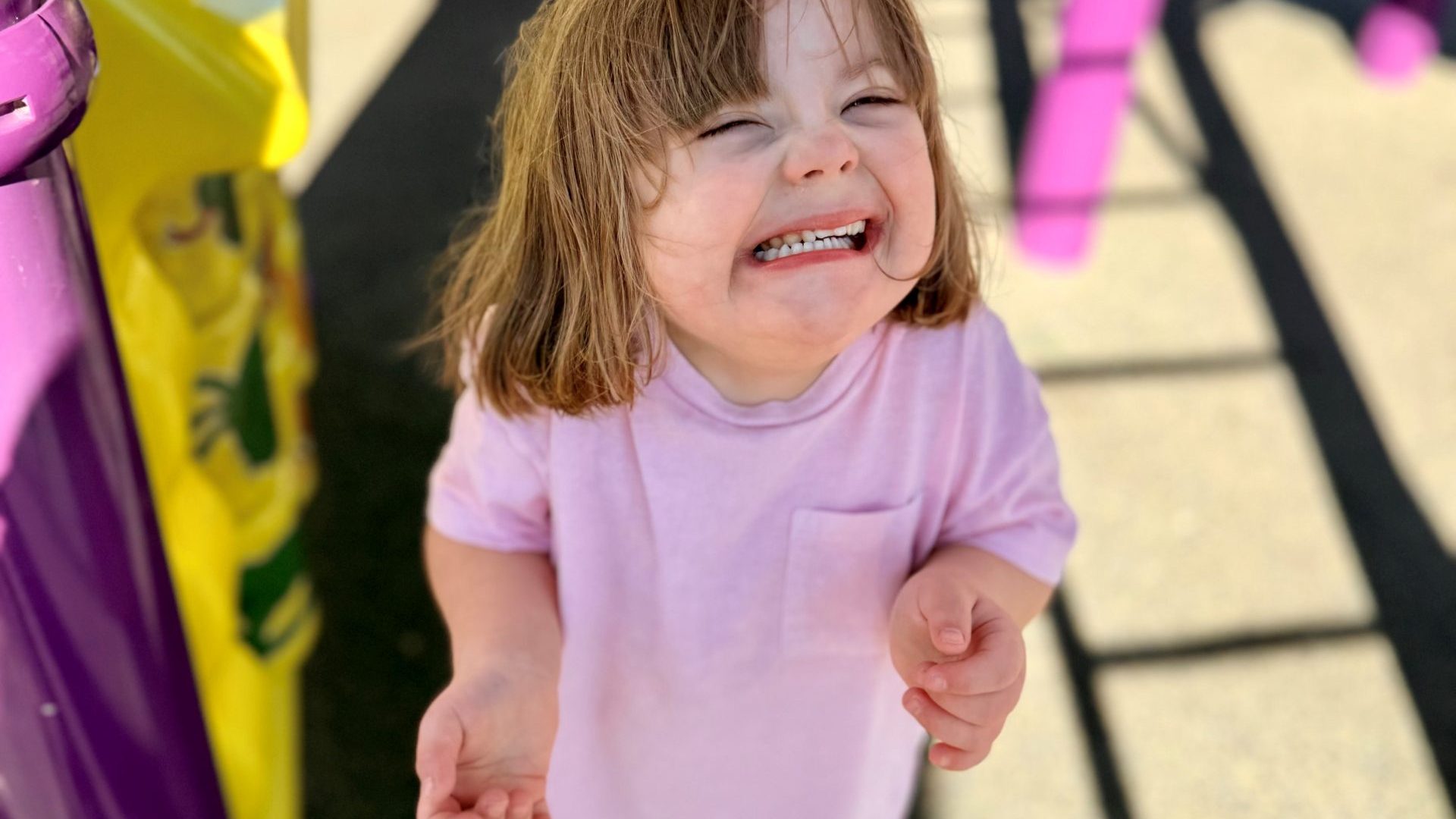
I get asked this question more often than people might realize: “Why do you share Kay online?” Sometimes it’s asked with genuine curiosity. Other times, there’s an unspoken concern tucked underneath it.
The simple answer? Because representation matters—every single day, not just during awareness months. Kay exists in multiple worlds that are still widely misunderstood: Down syndrome, autism, Type 1 diabetes, and life with a service dog. None of those things define her entirely, but all of them shape how she experiences the world—and how the world responds to her.
When I share Kay, I’m not doing it for sympathy. I’m not doing it for attention. I’m doing it because visibility creates understanding, and understanding creates change. Before Kay, I didn’t realize how much of society’s perception is built on stereotypes or absence. If you never see children with Down syndrome just living their lives—going to school, melting down in Target, celebrating birthdays, managing medical needs—you start to believe the narrow version of the story you’ve been told.
The same is true for autism. For Type 1 diabetes. For service dogs. People see pieces, not the whole picture. They see “diabetes” and think food restrictions. They see a service dog and assume it’s optional—or question why a child “needs that.” They see Down syndrome and underestimate intelligence, capability, or potential.
What they don’t see is the planning, the advocacy, the constant calculations, the flexibility, the exhaustion, the joy, the resilience—and the normalcy woven through it all.
By sharing Kay online, I’m inviting people into a more honest picture. I want parents who are new to these diagnoses to stumble across our page and think, “Okay… maybe we can do this.” I want kids who look like Kay to see themselves reflected and valued. I want educators, family members, strangers in grocery stores—to learn without needing to ask intrusive questions or make assumptions.
And maybe most importantly, I want Kay to grow up knowing that her story was never something to hide. Representation isn’t about oversharing. It’s about truth-telling. It’s about showing that children with complex needs don’t live small lives—they live full ones, even if they look different than expected. I don’t just share the hard days, and I don’t just share the wins. I share the in-between. Because that’s where real life happens.
Kay is more than her diagnoses—but her diagnoses are part of her story. And her story deserves to be seen, heard, and respected year-round. If sharing her journey helps even one person understand a little more, judge a little less, or feel a little less alone—then it’s worth it. Always.